Marketing Framework B2B Complete Guide — Funnel, Customer Journey, KPI ปี 2026
marketing framework b2b ครบทั้ง Funnel, Customer Journey, RACE, AARRR, JTBD, ICE, Growth Loop, KPI tree — pillar guide ที่นำไปใช้กับธุรกิจ B2B ไทยได้ทันที

Marketing Framework B2B Complete Guide — Funnel, Customer Journey, KPI ปี 2026
Last updated: 2026-05-28
Key Takeaways: marketing framework b2b ที่ work ปี 2026 ไม่ใช่การเลือก “framework เดียวที่ใช่” — แต่คือการเลือก framework ที่ฟิตกับ stage ของธุรกิจ + decision ที่ต้องตอบ Framework สำคัญที่ B2B ทุกคนควรรู้: Funnel + Customer Journey (mapping), AARRR / RACE (growth metrics), JTBD (positioning), ICE / RICE (prioritization), Growth Loop (compound channels), KPI Tree (hierarchy of metric) สำหรับ B2B Thai SME (50-500 พนักงาน) ที่ revenue 30-300M บาท framework ที่ recommended เริ่มจาก: Customer Journey Map → KPI Tree → Growth Loop hypothesis → ICE prioritization → execute weekly sprint บทความนี้ครอบคลุม 10+ framework พร้อม decision matrix ว่าใช้เมื่อไหร่ + ตัวอย่างการ apply ใน B2B Thai
ในโลกของ B2B marketing มี framework เกินกว่า 100 ตัว — Funnel, RACE, AARRR, JTBD, Hooked, AIDA, ICE, OKR, V2MOM, North Star Metric, Growth Loop, Bowtie Funnel, ฯลฯ
ปัญหาของ marketer ส่วนใหญ่ไม่ใช่ “ไม่รู้ framework” — แต่คือ เลือก framework ผิด สำหรับ business stage หรือ decision ที่กำลังตอบ
ผลคือ team execute เร็ว แต่ direction ผิด หรือ stuck ที่ “framework analysis paralysis”
บทความนี้คือ pillar guide ของ marketing framework b2b ที่ครอบคลุม 10+ framework ใหญ่ พร้อม decision matrix ว่าใช้ตัวไหนเมื่อไหร่ + ตัวอย่างที่ apply ใน B2B Thai
marketing framework b2b คืออะไร — Definition + Purpose
marketing framework b2b คือ structured model ที่ B2B team ใช้เพื่อ:
1. Understand customer / market / channel
2. Decide allocation of effort + budget
3. Execute consistent action across team
4. Measure outcome with shared metric
Framework ที่ดี = simplification ที่ retain insight — ตัด complexity ที่ไม่ค่อย impact ออก เหลือสิ่งที่ matter
⚠️ Framework ไม่ใช่:
– ❌ Recipe ที่ทำตามแล้วได้ผล (เป็น lens สำหรับ thinking)
– ❌ Replacement of strategy (เป็น tool ของ strategy)
– ❌ One-size-fits-all (ต้องเลือกให้ตรง context)
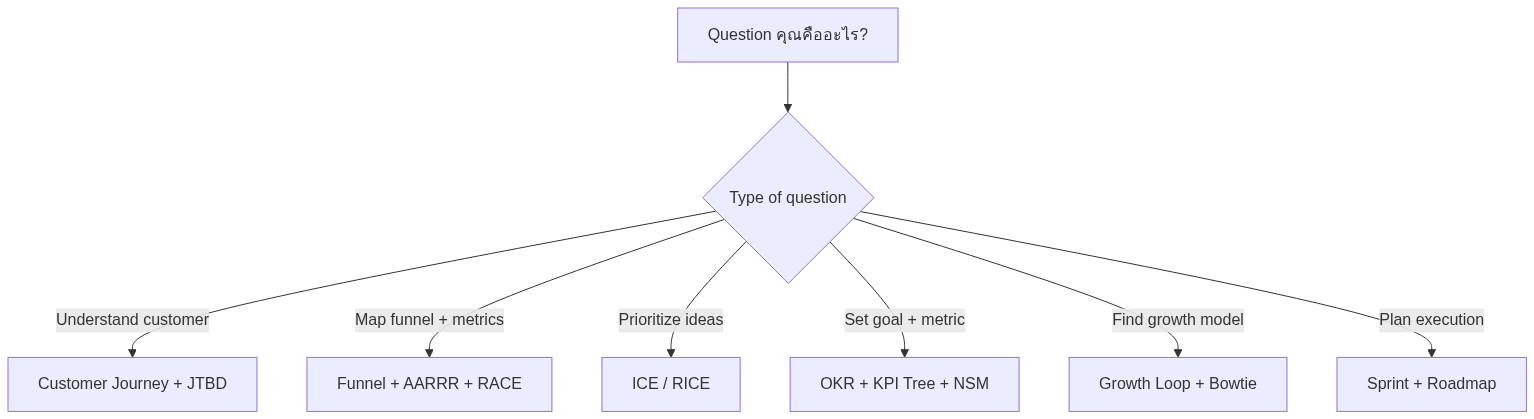
Decision Matrix — เลือก Framework ตาม Goal
Framework 1 — Customer Journey Map
ใช้เมื่อ: วาง content strategy, ออกแบบ touchpoint, identify gap ใน customer experience
โครงสร้าง
| Stage | Customer mindset | Channel | Content type | Goal |
|---|---|---|---|---|
| Awareness | “มีปัญหานี้, ใครพูดถึงบ้าง?” | SEO, Social, PR | Educational article, podcast | Build awareness |
| Consideration | “Solution มีอะไรบ้าง?” | Comparison page, webinar | Comparison guide, demo video | Get on shortlist |
| Decision | “เลือกตัวไหน?” | Sales call, case study | ROI calculator, case study | Win deal |
| Onboarding | “ใช้งานยังไงให้ได้ผล?” | Email, in-app | Tutorial, success plan | Activation |
| Retention | “ยังคุ้มอยู่ไหม?” | CSM, support | QBR, training, community | Renewal |
| Advocacy | “แนะนำใครได้?” | Referral program | Co-marketing, testimonial | Referral + LTV |
B2B Specific Note
- B2B journey ไม่ linear — ลูกค้าวนกลับมา research บ่อย
- 5-10 คนใน buying committee = ต้องมี content สำหรับ persona ต่าง
- Decision stage มัก take 3-12 เดือน
Framework 2 — Jobs to Be Done (JTBD)
ใช้เมื่อ: วาง positioning, design product/service, write copy ที่ resonate
Core Idea
ลูกค้าไม่ซื้อ product/feature — แต่ “hire” product เพื่อทำ job ให้จบ
ตัวอย่าง:
– ไม่ใช่: “ลูกค้าซื้อ CRM”
– แต่: “ลูกค้า hire CRM เพื่อ stop forgetting follow-up + report ให้ founder ได้”
JTBD Statement Template
When [situation],
I want to [motivation],
So I can [outcome].
ตัวอย่าง B2B:
When my sales team has 100+ open deals,
I want to know which deal to follow-up first today,
So I can hit Q3 quota without working weekends.
ใช้ทำอะไร
- Copy ที่ตรง job > spec ที่ดูดี
- Roadmap ที่ tied to job > feature wishlist
- Positioning ที่ unique > generic claim
Framework 3 — RACE Funnel
ใช้เมื่อ: plan multi-channel campaign, measure cross-channel effectiveness
Stages
| Stage | คืออะไร | Metric |
|---|---|---|
| Reach | สร้าง awareness | Impression, reach, brand search |
| Act | Engagement | Click, time-on-site, downloads |
| Convert | Conversion | Lead, sale, MQL |
| Engage | Retention + advocacy | Repeat purchase, NPS, referral |
ดีกว่า Traditional Funnel ตรงไหน
- เพิ่ม Engage stage (retention) — ที่ funnel แบบเก่าละเลย
- Map ทั้ง paid + organic ได้
- เน้น metric ที่ track ได้จริง
Framework 4 — AARRR (Pirate Metrics)
ใช้เมื่อ: SaaS / D2C / digital product, growth experimentation
Stages
| Letter | Stage | Metric |
|---|---|---|
| Acquisition | ดึง user มา | Visit, signup |
| Activation | First “aha” moment | Onboarding complete, key action |
| Retention | กลับมาใช้ซ้ำ | DAU/MAU, retention curve |
| Referral | บอกต่อ | Referral rate, viral coefficient |
| Revenue | ทำเงิน | ARPU, LTV |
B2B SaaS Adaptation
| AARRR | B2B Equivalent |
|---|---|
| Acquisition | Lead / Trial signup |
| Activation | Reach activation milestone (e.g., 3 user added, first integration) |
| Retention | MRR retention, weekly active workspace |
| Referral | NPS > 9 → referral, customer advocacy |
| Revenue | MRR / ARR, expansion revenue |
Framework 5 — Bowtie Funnel
ใช้เมื่อ: B2B subscription / recurring revenue business, mature stage
Concept
Traditional funnel จบที่ “purchase” — แต่ B2B subscription business มี post-sale ที่สำคัญพอ ๆ กับ pre-sale
    [TOFU]                    [Post-sale TOFU]
      ↓                            ↑
    [MOFU]                    [Expansion]
      ↓                            ↑
    [BOFU]   →  [Customer]  →   [Retention]
                                   ↑
                              [Onboarding]
Key Metric per Stage
- Pre-sale: lead → MQL → SQL → customer (efficiency)
- Onboarding: time-to-value, activation rate
- Retention: GRR (Gross Revenue Retention) — target 90%+
- Expansion: NRR (Net Revenue Retention) — target 110%+
Insight: B2B SaaS ที่ NRR > 120% = growth จาก existing customer มากกว่า new — economics สวยงาม
Framework 6 — Growth Loop
ใช้เมื่อ: หา sustainable channel ที่ scale ได้, แทน funnel-thinking
Concept
Funnel = linear (acquire → activate → revenue → end)
Growth Loop = circular — output → input ของรอบถัดไป
ตัวอย่าง Growth Loop
1. Content Loop (B2B SEO)
สร้าง content → ติด Google → traffic → backlink + brand search → content ใหม่ติดง่ายขึ้น → loop
2. Referral Loop
ลูกค้าใหม่ → ส่งมอบ value → referral → new lead → ลูกค้าใหม่ → loop
3. UGC Loop
User สร้าง content → คน follow / share → ติดดูข้อมูล brand → join → สร้าง content ใหม่ → loop
4. Network Effect Loop
User เพิ่ม → value ของ platform เพิ่ม → ดึง user ใหม่ → loop
Why Growth Loop > Funnel
- Compounding effect — รอบหลังถูกกว่ารอบแรก
- Defensible — คู่แข่งลอกยาก
- Sustainable — ไม่ต้องเพิ่ม budget เพื่อ growth ต่อ
Framework 7 — ICE / RICE Prioritization
ใช้เมื่อ: มี idea เยอะ ต้องเลือกทำตัวไหนก่อน
ICE Score
ICE = Impact × Confidence × Ease
- Impact: ถ้าทำสำเร็จ จะมีผลแค่ไหน (1-10)
- Confidence: มั่นใจแค่ไหนว่าจะสำเร็จ (1-10)
- Ease: ทำง่ายแค่ไหน — เวลา + resource (1-10)
Score รวม → เรียง prioritize
RICE (ใช้ใน product team)
RICE = (Reach × Impact × Confidence) / Effort
- Reach: กี่คน/account ที่ได้ผล (number)
- Impact: ระดับผลกระทบ (0.25 / 0.5 / 1 / 2 / 3)
- Confidence: % มั่นใจ
- Effort: person-months
Framework 8 — North Star Metric (NSM) + KPI Tree
ใช้เมื่อ: align ทีมทั้งบริษัทกับเป้าหมายเดียว
North Star Metric
1 metric ที่ represent core value ของ business
ตัวอย่าง NSM:
| Business type | NSM ตัวอย่าง |
|—|—|
| B2B SaaS | Weekly Active Workspaces |
| Marketplace | GMV per active buyer |
| B2B consulting | Pipeline value generated |
| B2B SaaS PLG | Daily Active Users × Avg deal size |
| Newsletter | Engaged subscribers (read > 50%) |
KPI Tree
ลำดับ metric จาก North Star ลงสู่ leading indicator
North Star: Weekly Active Workspaces
├── Acquisition: New signups/week
│   ├── Traffic (organic + paid)
│   └── Signup conversion rate
├── Activation: % new signup → first key action
│   ├── Onboarding completion
│   └── Time-to-value
└── Retention: WAU/MAU ratio
    ├── Weekly login rate
    └── Feature adoption rate
ทำไม KPI Tree สำคัญ
- ทุกคนเข้าใจว่า work ของตน ส่งผลกับ NSM ยังไง
- Identify bottleneck — leading indicator ตัวไหน drag NSM
- ลด disagreement — “เพิ่ม X” → ดู KPI Tree ว่า X ส่งผลกับ NSM ไหม
Framework 9 — OKR (Objectives + Key Results)
ใช้เมื่อ: set quarterly goal, align team across function
Structure
Objective: [qualitative, inspiring statement]
  KR 1: [quantitative, measurable]
  KR 2: [quantitative, measurable]
  KR 3: [quantitative, measurable]
ตัวอย่าง B2B Marketing OKR (Q3 2026)
Objective: Build qualified lead engine for sales team
- KR 1: Generate 200 MQL (+50% from Q2)
- KR 2: MQL → SQL conversion ≥ 30%
- KR 3: Average MQL cost ≤ ฿1,500
Best Practice
- 3-5 OKR/quarter (ไม่เกิน)
- 3-5 KR ต่อ Objective
- KR ต้อง measurable + time-bound
- Target = stretch (70% completion = success)
Framework 10 — Bullseye Framework (Channel Selection)
ใช้เมื่อ: start-up / new product, ยังไม่รู้ channel ไหน work
3 Rings
[Inner ring: 1-2 channel ที่ working ตอนนี้]
[Middle ring: 5-7 channel ที่ promising]
[Outer ring: 19 traction channels ที่ "could try"]
19 Traction Channels (จากหนังสือ “Traction”):
SEO, SEM, Social ads, Content marketing, Email marketing, PR, Trade show, Speaking engagement, Community, Affiliate, Sales, Business development, Direct sales, Existing platform, Viral marketing, Engineering as marketing, Targeted ads, Offline ads, Other
Process
- Brainstorm outer ring — ใส่ channel ที่อาจ work
- Move to middle ring — pick 5-7 channels ที่ลอง test
- Run cheap test — 1-2 สัปดาห์ per channel
- Move to inner ring — channel ที่ work — double down
Framework 11 — Sprint / Weekly Cadence
ใช้เมื่อ: execution, ทำให้ team ship เร็ว + วัดผล
Marketing Sprint Format (1 สัปดาห์)
Monday:
– Sprint planning 1 ชม.
– Review last week (metric, learning)
– Pick 3-5 task for this week (each = 1 person-day max)
Tuesday-Thursday:
– Execute
– Daily standup 15 นาที (block/update)
Friday:
– Retro 30 นาที (what went well, what to change)
– Ship summary to stakeholder
Why Weekly Cadence
- B2B marketing pace = 1-2 สัปดาห์ feedback loop work ดี
- Monthly = ช้าเกิน, daily = noise
- Quarter retro → adjust framework
Decision Tree — Framework ไหนใช้เมื่อไหร่
| ถ้าคุณ… | ใช้ framework |
|---|---|
| Map customer touchpoint | Customer Journey |
| หา product-market fit | JTBD + Customer Interview |
| Set quarterly goal | OKR + NSM |
| Plan campaign | RACE + Channel mix |
| Track SaaS growth | AARRR + Bowtie |
| Find sustainable channel | Growth Loop + Bullseye |
| Prioritize backlog | ICE / RICE |
| Align team metric | KPI Tree |
| Execution velocity | Weekly Sprint |
Common Mistakes ของการใช้ Framework
1. Framework Worship
- ใช้ framework เพราะ trendy ไม่ใช่เพราะ fit
- ทางออก: ถามก่อน “ตอบ question อะไร” ก่อนเลือก framework
2. Multiple Framework ทับซ้อน
- ทุก meeting ลาก framework ใหม่ → team confused
- ทางออก: เลือก 3-5 framework “ทางการ” ของบริษัท
3. Framework แทน Strategy
- Framework = tool, strategy = decision
- ทางออก: strategy ก่อน framework ตาม
4. ไม่ Customize ตาม Context
- Copy framework จาก US SaaS มาใช้กับ B2B Thai
- ทางออก: adapt benchmark + metric ตาม market
5. Track Metric ที่ไม่ Lead to Decision
- Vanity metric (impression, follower) ไม่ทำให้ตัดสินใจอะไร
- ทางออก: ทุก metric ต้อง answer “ถ้า metric นี้ขึ้น/ลง 20% เราจะทำอะไรต่าง?”
Tools — Framework Implementation
| Tool | Used for | ราคา/เดือน |
|---|---|---|
| Notion / Airtable | KPI tree + OKR tracking | $0-20 |
| Miro / FigJam | Customer journey + workshop | $0-25 |
| Linear / Asana | Sprint + task | $0-30 |
| Mixpanel / Amplitude | AARRR funnel analysis | $0-300 |
| GA4 + Looker Studio | Dashboard for KPI Tree | Free |
| Tally / Typeform | Survey for JTBD research | $0-50 |
| Calendly + Loom | Customer interview | $0-30 |
Action Plan — Implement Framework Stack ใน 60 วัน
Week 1-2: Foundation
– Workshop: define North Star Metric
– Build KPI Tree (NSM → leading indicator)
– Customer interview 5-7 ราย (JTBD)
Week 3-4: Mapping
– Customer Journey Map (ที่ verified จาก interview)
– Identify gap + opportunity
Week 5-6: Planning
– Set quarterly OKR (3-5 objectives)
– ICE-prioritize backlog → top 10 initiative
Week 7-8: Execution Setup
– Sprint cadence (weekly Monday-Friday)
– Dashboard ที่ link KPI Tree → real data
– Retro framework
สรุป
marketing framework b2b ไม่ใช่ “เลือกตัวที่ดีที่สุด” — แต่คือ เลือกตัวที่ตอบ question ของคุณตอนนี้
หลักการสำคัญ:
– Question first, framework second
– Stack framework เป็นชั้น: strategy (JTBD, NSM) → planning (OKR, ICE) → execution (Sprint)
– Adapt > Adopt — customize ตาม context
– Metric ต้อง lead to decision
– Iterate framework ทุก quarter — สิ่งที่ work Q1 อาจไม่ work Q3
อ่านต่อ:
– Content Marketing B2B Guide — content engine framework
– Marketing Automation B2B Guide — automation framework
– Attribution Model B2B Guide — measurement framework
– In-house Marketing vs Agency — org framework
ถ้าอยากให้ทีม Adsitec ช่วย workshop framework ที่ฟิตกับ B2B ของคุณ — นัดคุย 60 นาที