Privacy & First-Party Data B2B Guide — PDPA, Cookieless, Consent ปี 2026
privacy marketing b2b ที่ครอบคลุม PDPA, cookieless era, consent management, server-side tracking, first-party data strategy สำหรับ B2B ไทย — pillar guide ฉบับสมบูรณ์

Privacy First-Party Data B2B Guide — PDPA, Cookieless, Consent ปี 2026
Last updated: 2026-05-28
Key Takeaways: privacy marketing b2b ในปี 2026 ไม่ใช่แค่ “ทำตามกฎหมาย” — แต่คือ competitive advantage ที่แบรนด์ใช้สร้าง trust + first-party data ที่ accurate กว่าคู่แข่ง ปัจจัยที่เปลี่ยน landscape ปี 2026: (1) PDPA ไทย บังคับใช้เต็มรูปแบบ (2) Cookieless era — Chrome เลิก 3rd-party cookie + iOS/Android tracking restrictions (3) AI scraper ที่ดึง data จากเว็บ Framework ที่ work: First-party data foundation + Consent management platform (CMP) + Server-side tracking + Customer Data Platform (CDP) สำหรับ B2B ไทย benchmark ที่ healthy: 70-90% ของ tracking data via first-party, consent opt-in rate > 60%, PDPA compliance audit ผ่าน ปี 1 ของการ implement system นี้มัก ROI สูงเพราะ data quality ดี + ลด risk fine ที่อาจเสีย 5 ล้านบาทขึ้นไป
ปี 2026 คือจุดเปลี่ยนสำคัญของ marketing data — สิ่งที่ทีม marketing เคยพึ่งมา 10+ ปี (3rd-party cookie, cross-site tracking, broad targeting) หายไป ทีละน้อยจาก browser update + privacy law
ในไทยเฉพาะปี 2025-2026 มี 3 เปลี่ยนแปลงใหญ่:
1. PDPA (Personal Data Protection Act) บังคับใช้เต็มรูปแบบ + DPC เริ่ม enforce
2. Chrome เลิก 3rd-party cookie (delayed หลายรอบ แต่กำลังเข้าสู่ phase-out)
3. AI scraper (ChatGPT, Perplexity, Anthropic) ดึง content + data ของแบรนด์โดยไม่ขอ
ทีม B2B ที่ตอบสนองช้า = เสียทั้ง 2 ทาง — โดน fine + เสีย competitive edge
บทความนี้คือ pillar guide ของ privacy marketing b2b ที่ครอบคลุม PDPA, cookieless prep, consent management, server-side tracking, first-party data strategy ที่ใช้ได้จริงสำหรับ B2B ไทย ปี 2026
privacy marketing b2b คืออะไร — Scope
privacy marketing b2b คือกรอบของ practice + technology + legal compliance ที่ B2B brand ใช้:
1. Collect customer data อย่างถูกต้อง (consent)
2. Store + process data อย่างปลอดภัย (security)
3. ใช้ data สำหรับ marketing โดยเคารพ user choice
4. รักษา compliance กับ regulation (PDPA, GDPR ถ้ามีลูกค้า EU)
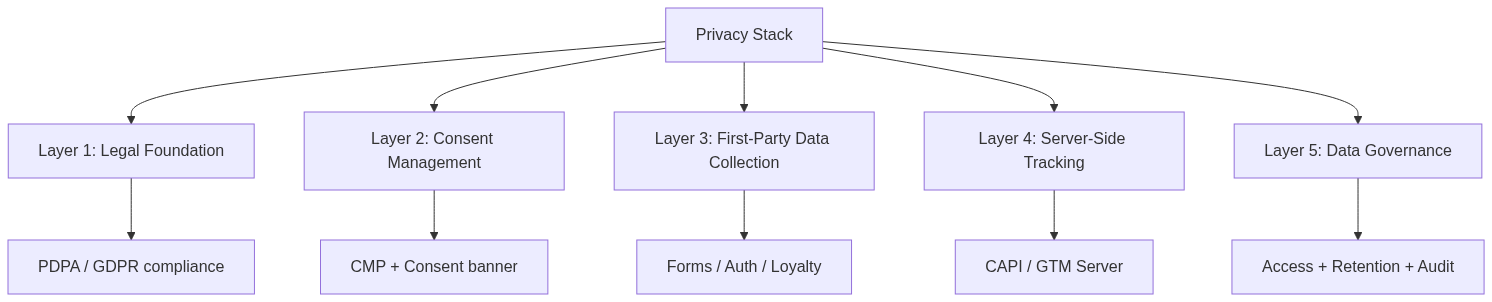
ครอบคลุม 5 มิติ:
| มิติ | คืออะไร |
|---|---|
| Legal compliance | PDPA + GDPR + sectoral regulation |
| Consent management | UI/UX + technical for capturing valid consent |
| First-party data strategy | Collect + own data ที่ไม่ต้องพึ่ง 3rd party |
| Server-side tracking | Tracking ที่ accurate + privacy-respecting |
| Data governance | Internal policy + access control + retention |
ทำไม Privacy = Competitive Advantage ใน B2B
หลายคนคิดว่า “privacy = cost center” — ผิดในปี 2026
3 เหตุผลที่ privacy = advantage:
1. First-party data accuracy
- Brand ที่มี first-party data structure ดี = targeting accurate กว่า 30-50%
- ROAS ดีกว่าอย่างเห็นได้ชัด เพราะลด wasted spend
2. Trust signal สำหรับ Enterprise buyer
- Enterprise procurement ขอ data security audit ก่อนเซ็น contract
- Brand ที่ pass = ผ่าน RFP stage ที่หลายคู่แข่ง stuck
3. AI Search advantage
- Content ที่ structured + own data = AI cite บ่อยขึ้น
- ดู GEO Complete Guide
The Privacy Stack — 5 Layer Framework
Layer 1 — PDPA Compliance สำหรับ B2B ไทย
PDPA Essential — 6 ประเด็นที่ marketer ต้องรู้
1. Personal Data Definition
– ข้อมูลที่ระบุตัวบุคคลได้ → ครอบคลุม: ชื่อ, email, phone, IP, cookie ID, behavioral data
– B2B ก็เข้าข่าย — ข้อมูลของ business contact = personal data
2. Legal Basis ที่ใช้ได้ (6 ข้อ)
– ✅ Consent — explicit opt-in (most common สำหรับ marketing)
– ✅ Contract — necessary for service delivery
– ✅ Legal obligation — บังคับโดยกฎหมาย
– ✅ Vital interest — protect life
– ✅ Public task — official duty
– ✅ Legitimate interest — ของ controller (with balancing test)
สำหรับ marketing email/ads — Consent เป็น default ที่ปลอดภัยที่สุด
3. Data Subject Rights (8 สิทธิ)
ต้อง provide mechanism ให้ user:
– Right to access
– Right to rectification
– Right to erasure (“right to be forgotten”)
– Right to restrict processing
– Right to data portability
– Right to object
– Right to withdraw consent
– Right to lodge complaint
4. DPO (Data Protection Officer)
– บังคับสำหรับ:
– Public agency
– Organization ที่ process sensitive data ขนาดใหญ่
– Core activity = systematic monitoring on large scale
– B2B SME ส่วนใหญ่ไม่บังคับ แต่ recommended มี “privacy contact person”
5. DPIA (Data Protection Impact Assessment)
– บังคับสำหรับ high-risk processing
– รวม: large-scale profiling, AI-driven decision, sensitive data
6. Penalty
– Administrative fine: up to ฿5,000,000 per violation
– Criminal: imprisonment + fine
– Civil: damages claim from affected individual
B2B Marketing-specific PDPA Checklist
- ✅ Cookie banner ที่ active opt-in (ไม่ใช่ pre-checked)
- ✅ Privacy policy ที่ระบุ purpose + data type + retention + 3rd party
- ✅ Email opt-in double opt-in (recommended)
- ✅ Lead form ที่ระบุชัด consent for marketing communication
- ✅ Unsubscribe ทำงานทันที (≤ 5 วัน per PDPA)
- ✅ Data Processor Agreement (DPA) กับทุก 3rd party (Google Ads, Meta, MailChimp ฯลฯ)
- ✅ Internal access control — เฉพาะคนที่ need-to-know
- ✅ Audit log ของ data access + modification
- ✅ Incident response plan สำหรับ data breach (notify ภายใน 72 ชั่วโมง)
Layer 2 — Consent Management Platform (CMP)
CMP Components
1. Cookie banner
– แสดงตอน first visit
– Option ที่ “Accept all” + “Reject all” + “Customize”
– ไม่ pre-check box
2. Preference center
– User เปลี่ยน setting ได้ตลอด
– Granular control: necessary / analytics / advertising / personalization
3. Consent record
– Timestamp + IP + user agent + version of policy
– เก็บ proof สำหรับ audit
4. Integration
– Connect ออก Google Tag Manager + ad pixel
– Block tag จนกว่า user consent
CMP Options สำหรับ B2B Thai
| CMP | ราคา | Best for |
|---|---|---|
| Cookiebot | $9-50/mo | SME, multi-language |
| OneTrust | $$$ enterprise | Large enterprise, multi-jurisdiction |
| CookieYes | $0-25/mo | Small site, simple needs |
| Termly | $0-49/mo | Bundle privacy policy + CMP |
| Custom in-house | dev time | Specific needs + control |
Best Practice UX
- ✅ Banner ไม่บัง critical content
- ✅ Language ตรง audience (ไทย + English)
- ✅ “Reject all” ปุ่มเด่นเท่ากับ “Accept all” (PDPA + GDPR requirement)
- ✅ Granular toggle ที่ easy เข้าใจ
- ❌ Dark pattern (เช่น “Accept” สีสด, “Reject” เทาเล็ก)
Consent Opt-in Rate Benchmark
| Quality of CMP | Opt-in rate |
|---|---|
| Aggressive design (dark pattern) | 80-90% but legally risky |
| Balanced design (recommended) | 50-70% |
| Compliance-strict | 30-50% |
Insight: ตั้ง target 50-70% — สูงพอจะมี data work + compliant พอจะไม่โดน complaint
Layer 3 — First-Party Data Strategy
First-Party Data คืออะไร
Data ที่ brand เก็บ เอง จาก customer interaction:
– Email subscriber list
– Customer profile + behavior
– Purchase history
– Survey response
– Support ticket history
ต่างจาก:
– 2nd-party data: จาก partner (เช่น co-marketing)
– 3rd-party data: ซื้อจาก data broker (ใช้ยากใน cookieless era)
Why First-Party Data Matters
| ปัจจัย | First-party | 3rd-party |
|---|---|---|
| Accuracy | High | Medium-Low |
| Privacy compliance | Easy | Hard |
| Cost | Cheap (own) | Expensive |
| Cookieless impact | Resilient | Severe |
| Targeting quality | High | Decaying |
Collection Channels สำหรับ B2B
1. Lead form
– Contact form, demo request, trial signup
– Required field: minimum viable (over-asking = drop-off)
2. Email subscriber
– Newsletter signup
– Lead magnet download
– Webinar registration
3. Account / Login
– Customer portal
– Self-service account
– Community membership
4. Loyalty / Referral program
– Reward for referral
– Tier-based benefit
5. Survey / Feedback
– NPS survey
– Post-purchase survey
– Annual customer survey
First-Party Data Quality
Healthy benchmark:
– 70%+ ของ tracking data via first-party
– < 20% data row มี missing critical field
– Update frequency: real-time หรือ daily
– De-dup rate: < 5% duplicate
Layer 4 — Server-Side Tracking
ทำไม Server-side Tracking สำคัญ
3rd-party cookie ตาย → client-side tracking accuracy ลดลงเรื่อย ๆ:
– Apple ITP block tracking
– Brave / Firefox block tracking
– AdBlock penetration > 30% ใน developed market
Server-side tracking = ส่ง event จาก server ของ brand → ad platform โดยตรง:
– Bypass browser restriction
– Better data accuracy
– Privacy-respecting (filter sensitive data ได้)
Implementation Options
1. Google Tag Manager Server-Side
– Setup container บน GCP / cloud
– Forward client event → server → ad platform
– Most flexibility
2. Conversion API (CAPI)
– Meta CAPI
– TikTok Events API
– LinkedIn Conversions API
– Pinterest Conversions API
– ทุก platform หลักมี
3. Hybrid Approach
– GTM client-side สำหรับ engagement event
– Server-side / CAPI สำหรับ conversion event
Setup Effort
| Approach | Setup time | Maintenance | Cost |
|---|---|---|---|
| CAPI only (per platform) | 4-8 hours / platform | Low | $0 |
| GTM Server-side | 2-4 days | Medium | ~$50-200/mo GCP |
| Enterprise CDP + Server-side | 1-3 months | High | $1,000+/mo |
อ่านเพิ่ม: MarTech Analytics & Tracking Guide — pillar ครอบคลุม GA4 + GTM + CAPI
Layer 5 — Data Governance
Internal Policy
Access Control
– Role-based access — ใครเข้าได้ data อะไร
– Principle of least privilege
– Audit log ทุก access
– Review access list ทุก quarter
Data Retention Policy
– Active customer: indefinite (with periodic consent renewal)
– Inactive 12 เดือน: archive
– Inactive 24 เดือน: anonymize หรือ delete
– Marketing lead 6 เดือน: re-engage หรือ delete
Vendor / Processor Management
– DPA (Data Processor Agreement) กับทุก 3rd party
– Audit vendor security ทุกปี
– Plan สำหรับ vendor exit (data portability)
Incident Response
Breach Response Plan:
1. Detect — monitoring + alert
2. Contain — stop further leak
3. Assess — scope + severity
4. Notify — DPC (72 ชั่วโมง) + affected individual (high risk)
5. Remediate — fix root cause
6. Document — for audit
Cookieless Era Prep — Checklist 12 ข้อ
| Priority | Action | Effort |
|---|---|---|
| 🔴 | Setup Conversion API ทุก ad platform | Medium |
| 🔴 | Implement GTM Server-side | High |
| 🔴 | Audit consent banner — ensure granular + balanced | Low |
| 🔴 | Build email list (own database) | Continuous |
| 🟡 | Move from 3rd-party audience → 1st-party + lookalike | Medium |
| 🟡 | Setup CRM/CDP — centralize customer data | High |
| 🟡 | Customer authentication (login) — better data quality | Medium |
| 🟡 | Loyalty / membership program — incentive for data sharing | High |
| 🟢 | Move from demographic targeting → behavioral / contextual | Low |
| 🟢 | Update privacy policy + consent record | Low |
| 🟢 | Train marketing team on PDPA basic | Low |
| 🟢 | Annual privacy audit | Medium |
Common Mistakes ของ B2B Privacy ในไทย
1. คิดว่า “B2B = ไม่ใช่ personal data”
- B2B contact = personal data ตาม PDPA
- ทางออก: treat B2B email/data เหมือน B2C compliance
2. ใช้ “legitimate interest” สำหรับ marketing
- ส่วนใหญ่ marketing ไม่ผ่าน balancing test ใน PDPA
- ทางออก: ใช้ explicit consent
3. Cookie banner แบบ “Accept all” ปุ่มเดียว
- ไม่ compliant
- ทางออก: ต้องมี Reject + Customize เด่นเท่ากัน
4. ไม่มี DPA กับ vendor
- เสี่ยง liability ถ้า vendor leak data
- ทางออก: ทุก SaaS ต้องเซ็น DPA — ส่วนใหญ่ available บน website
5. ไม่ update privacy policy ตาม practice จริง
- ส่งให้ลูกค้าเห็นแต่ไม่ตรง reality = violation
- ทางออก: review privacy policy ทุก 6 เดือน + after major change
6. ละเลย Right to Erasure request
- Ignore = direct violation + complaint
- ทางออก: build workflow ที่ respond < 30 วัน
7. ไม่มี Incident Response Plan
- เมื่อโดน breach = ไม่รู้ทำอะไร = ส่วนใหญ่จบที่ fine
- ทางออก: tabletop exercise ปีละ 1-2 ครั้ง
Tools — Privacy Stack สำหรับ B2B Thai
| Layer | Tool | ราคา/เดือน |
|---|---|---|
| CMP | Cookiebot / CookieYes / OneTrust | $9-$$$ |
| Privacy policy generator | Termly / Iubenda | $0-49 |
| CRM (first-party data) | HubSpot / Salesforce / Pipedrive | $15-150+ |
| CDP | Segment / RudderStack / customer.io | $100-1000+ |
| GTM Server-side | Google Cloud + GTM | $20-200 GCP |
| CAPI implementation | Stape / Server GTM templates | $50-200 |
| Data governance | Collibra / Atlan (enterprise) | $$$ |
| Incident response | Datadog / Sentry + manual SOP | $20-200 |
Stack ขั้นต่ำสำหรับ B2B Thai SME:
Cookiebot ($19) + HubSpot Free + GTM Server-side ($50 GCP) + Termly ($10) = ~$80/month
Action Plan — Privacy + First-Party Data ใน 90 วัน
เดือน 1: Compliance Foundation
– Week 1: PDPA audit — identify gap
– Week 2: Update privacy policy + consent banner
– Week 3: Implement CMP (Cookiebot)
– Week 4: DPA review กับทุก vendor
เดือน 2: First-Party Data Build
– Week 5: Audit data collection point ทั้งหมด
– Week 6: Setup CRM/CDP (HubSpot Free → upgrade ตามต้องการ)
– Week 7: Centralize subscriber list + customer database
– Week 8: Email + loyalty + referral structure
เดือน 3: Server-Side Tracking
– Week 9: Setup Meta CAPI + Google Enhanced Conversion
– Week 10: GTM Server-side container
– Week 11: Migration test
– Week 12: Validate accuracy + production cutover
สรุป
privacy marketing b2b ปี 2026 ไม่ใช่ optional — เป็น business critical
หลักการสำคัญ:
– Privacy = competitive advantage ไม่ใช่ cost
– First-party data = foundation ของ future-proof marketing
– Consent-based > legitimate interest สำหรับ marketing
– Server-side tracking = essential เมื่อ cookieless era มาเต็มที่
– Data governance = ไม่ใช่งานของ IT แต่ marketing ต้องเข้าใจ
อ่านต่อ:
– MarTech Analytics & Tracking Guide — pillar ของ analytics + GTM
– CRM B2B ไทย Guide — CRM = source of first-party data
– Marketing Automation B2B Guide — ใช้ first-party data ใน automation
– ตั้ง Facebook Pixel + CAPI — server-side สำหรับ Meta
ถ้าอยากให้ทีม Adsitec ช่วย audit privacy compliance + setup first-party data stack — นัดคุย 30 นาที