Content Marketing & SEO Strategy สำหรับธุรกิจไทย ปี 2026
คู่มือ Content Marketing + SEO Strategy สำหรับธุรกิจไทย ปี 2026 — programmatic SEO, topical authority, AI search (GEO), pillar-cluster model, internal linking, content velocity

Content Marketing SEO Strategy สำหรับธุรกิจไทย ปี 2026
TL;DR: Content + SEO ปี 2026 = Topical authority + Pillar-cluster + AI-aware (GEO) + Distribution-first. SEO เปลี่ยนจาก “rank for keyword” → “be the authority Google + AI ตอบจากคุณ”. คู่มือนี้ครอบคลุม: content strategy framework, pillar-cluster architecture, keyword research ปี 2026 (intent-first), programmatic SEO, AI search optimization (GEO/AEO), content velocity vs quality balance, internal linking, distribution strategy beyond Google, measurement, TH-specific considerations
Content + SEO ปี 2026 — เปลี่ยนไป 3 เรื่อง
1. AI Search Disruption
- Google AI Overviews/SGE — top of page, ไม่ต้องคลิกเข้าเว็บ
- ChatGPT, Perplexity, Gemini, Claude = “answer engine” แทน “search engine”
- Click-through rate ลดลงอย่างเห็นได้ชัด ใน บาง category (informational queries)
- Strategy: ต้องอยู่ใน AI training + retrieval data, ไม่ใช่แค่ rank #1
2. E-E-A-T Stricter
- Experience (จริงๆ ใช้/ทำมา) + Expertise + Authoritativeness + Trust
- Google penalize “AI-generated thin content” หนัก 2024-2025
- Need author bio, original research, first-hand experience
3. Content Velocity vs Depth Tradeoff
- Old: 1,000 thin articles → still rank
- New: 50 deep + comprehensive → rank + AI cite
- Pillar-cluster model wins
Content Strategy Framework
Step 1: Define Audience + Intent
- Who are you writing for? (specific persona)
- What stage of journey? (TOFU/MOFU/BOFU)
- What’s their pain? (specific, not generic)
Step 2: Map Topics → Search Behavior
- What do they search?
- What language? (Thai vs English vs mixed)
- What questions ask AI assistants?
Step 3: Decide Coverage Strategy
- Pillar-cluster — deep authority on focused topic
- Programmatic SEO — many pages at scale (templates + data)
- Linkable assets — original research, calculators, tools
- Distribution-first — write less, distribute more
Step 4: Execution Plan
- Editorial calendar
- Brief template
- Production process
- Update cadence
Pillar-Cluster Model (Recommended Default)
Anatomy
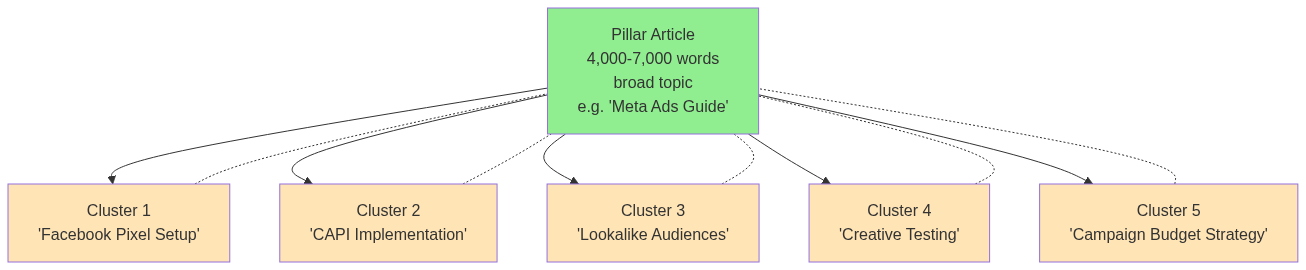
How it works
- Pillar — comprehensive, broad keyword, 4-7k words
- Clusters — specific, long-tail, 1.5-3k words
- Internal linking — pillar links to all clusters; clusters link back to pillar
- Topical authority — Google sees you cover topic deeply
Sizing your pillars
- B2B niche: 5-10 pillars
- D2C mid-market: 10-20 pillars
- Content site: 20-50+ pillars
- Each pillar = 5-15 clusters
Example pillar map (this site)
- Pillar 1: Meta Ads B2B → 10 clusters
- Pillar 2: Google Ads B2B → 10 clusters
- Pillar 3: MarTech Analytics → 8 clusters
- Etc.
Keyword Research 2026 — Intent-First
Old Way: Volume + Difficulty
- Find keywords by volume
- Filter by difficulty
- Write to keyword
New Way: Intent-First
- Identify customer questions
- Group by intent + journey stage
- Write to question, optimize for keyword
4 Intent Types
- Informational — “อะไรคือ X” — TOFU
- Navigational — “X login” — finds specific brand
- Commercial — “X รีวิว” / “X vs Y” — MOFU comparison
- Transactional — “ซื้อ X” / “X ราคา” — BOFU
Tools (TH-friendly)
- Google Keyword Planner — Free, official volume
- Ahrefs / Semrush — Paid, deep insights
- Ubersuggest — Cheaper alternative
- AnswerThePublic — Question discovery
- Reddit + Pantip search — Real questions
- AI chat tools — Ask “what do TH B2B marketers ask about X”
TH-Specific Keyword Patterns
- Mixed Thai-English: “facebook ads ทำยังไง”, “google ads ราคา”
- Long-tail questions: “เลือก agency ยังไง”
- Brand+ความหมาย: “X คืออะไร”, “X ใช้ยังไง”
- Comparison: “X กับ Y ต่างกันยังไง”
AI Search Optimization (GEO / AEO)
GEO = Generative Engine Optimization
ปรับ content ให้ AI (ChatGPT, Perplexity, Google AI Overviews) อ้างถึงเรา
AEO = Answer Engine Optimization
ปรับ content ให้เป็น answer ที่ AI assistants ใช้
Tactics
1. Structured Content (AI-friendly)
- Clear hierarchy (H1 > H2 > H3)
- Bulleted lists for “X เรียง 5 ข้อ”
- Tables for comparison
- Definition boxes at top of section
2. Direct Answers
- Opening paragraph = direct answer (TL;DR)
- Cite stats, methodology, sources
- Avoid fluff — get to point
3. Original Data
- Original research = most cited
- Survey results
- Internal data + analysis
- Quotes from experts
4. Schema Markup
- Article schema
- FAQ schema
- HowTo schema
- Author schema
- Organization schema
5. Get Cited Elsewhere
- Wikipedia mention
- Authoritative site backlinks
- AI training crawlers see you
6. Track AI Mentions
- Tools: Profound, Brand24, manual ChatGPT testing
- Monitor: brand name + topic queries
- Iterate: if not mentioned, gap exists
TH-Specific GEO
- Thai-language AI queries แตกต่าง — test ทั้ง Thai + English
- Pantip + TH forums เป็น source หลักของ TH AI training
- Wikipedia ภาษาไทย — get linked from there
Programmatic SEO
What is it
Generate many landing pages from template + data → rank for long-tail variations
Examples
- Real estate: “[Neighborhood] condos for sale” × 1000 areas
- SaaS: “[Tool A] vs [Tool B]” × all combinations
- E-com: “[Product] in [City]” × matrix
- B2B services: “[Service] for [Industry] in [Location]”
Requirements
- Database of variables
- Page template that’s actually useful (not thin)
- Internal linking strategy
- Quality control (Google penalizes spammy programmatic)
TH Application
- Industry × service pages (e.g. “MarTech consultant for healthcare in Thailand”)
- Location × service (“Meta Ads agency in Bangkok”)
- Product × use case
- Tool integration pages
Common Failures
- Pages too thin (just template)
- Duplicate content across variants
- No internal linking from main site
- No unique value per page
Content Velocity vs Depth
The Tradeoff
- Velocity: ปริมาณ + frequency
- Depth: คุณภาพ + comprehensive
When Velocity Wins
- New site (build authority signal fast)
- Programmatic SEO at scale
- News/timely content (เกาะ trend)
When Depth Wins
- Established site building authority
- Competitive keyword
- Pillar content
- Linkable assets
Sweet Spot Recommended
- 1 pillar / month (deep, 4-7k words)
- 3-5 clusters / month (focused, 1.5-3k each)
- Refresh existing every 3-6 months
TH Realistic Cadence
- Solo writer: 1 pillar + 2 cluster / month
- Small team (2-3 writers): 2 pillars + 6 clusters / month
- Larger team: scale linearly
Internal Linking Strategy
Why Critical
- Distribute authority across site
- Signal topic relationships to Google
- Guide user journey
- Pass crawl budget efficiently
Patterns
1. Hub & Spoke
- Pillar = hub
- Cluster = spoke
- Hub links to all spokes
- Spokes link back to hub
- Spokes link to related spokes
2. Contextual Inline Links
- Link in body text (not just “Related” section)
- Anchor text = topic-relevant
- 3-7 internal links per article
3. Breadcrumb + Category
- Site structure indicates topic depth
- Breadcrumb on every page
- Category archive optimized
Anchor Text Tips
- Vary (not always same phrase)
- Descriptive (not “click here”)
- Match topic of destination
- 1-5 words ideal
Common Mistakes
- Only link in “Related” section
- Same anchor text everywhere (over-optimization)
- Link to home page from every article
- Orphan pages (no links to them)
Distribution Strategy — Beyond Google
ปี 2026 — Google traffic เป็น 1 channel ใน 5+ ที่ต้อง distribute content
Owned
- Email newsletter (ส่ง pillar/cluster ใหม่)
- LINE OA broadcast (TH-specific)
- Push notification
Earned
- Backlinks (PR + outreach)
- Social shares
- Podcast features
- Speaker opportunities
Paid
- Content amplification (Meta promoted post)
- LinkedIn promoted (B2B)
- TikTok organic + boost
- Native ads (Outbrain/Taboola — TH less common)
Repurpose
- Pillar → Twitter thread
- Pillar → LinkedIn long post
- Pillar → YouTube video script
- Pillar → Podcast outline
- Cluster → Newsletter segment
TH-Specific
- Pantip thread (carefully — no spam)
- Facebook group sharing (relevant groups only)
- LINE OA broadcast
- TikTok TextBookMode videos
Measurement
KPIs by Funnel Stage
Awareness (TOFU)
– Organic traffic
– Brand search volume
– Social shares + mentions
– AI assistant citations
Engagement (MOFU)
– Time on page
– Scroll depth
– Pages per session
– Email signup rate
Conversion (BOFU)
– Conversion rate per article
– Assisted conversions (GA4)
– Demo requests / purchases from blog
Tools
- GA4 — traffic + engagement
- Google Search Console — search performance
- Ahrefs/Semrush — rankings + backlinks
- Hotjar/Microsoft Clarity — UX + heatmap
- Mention/Brand24 — brand mentions
Reporting Cadence
- Weekly: Traffic + top articles
- Monthly: Ranking changes + new article performance
- Quarterly: Full SEO audit + strategic review
Common Pitfalls
- Write for keyword, not user — content reads spammy
- Skip topical authority — random topics, no clusters
- AI-generated thin content — Google penalty
- No internal linking strategy — orphan pages
- Ignore AI search — losing visibility in AI Overviews
- No author E-E-A-T signals — no bio, no expertise displayed
- Single-channel SEO focus — Google traffic drops, no backup
- Never update old content — outdated articles drag rankings
- Programmatic SEO without quality — Google penalty
- Measure ranking only — miss engagement + conversion picture
Quick Start Checklist
Month 1 — Strategy + Foundation
- [ ] Define target personas (3-5)
- [ ] Map topic universe (pillar map)
- [ ] Keyword research per pillar
- [ ] Editorial calendar Q1
- [ ] Brief template + production process
Month 2-3 — First Pillars
- [ ] Write 2-3 pillars (4-7k words each)
- [ ] Write 5-10 clusters supporting pillars
- [ ] Setup internal linking matrix
- [ ] Schema markup
- [ ] Set up GA4 + Search Console
Month 4-6 — Velocity + Distribution
- [ ] Increase to 1 pillar + 4 cluster / month
- [ ] Newsletter launch
- [ ] LinkedIn/Twitter repurpose
- [ ] First backlink outreach
- [ ] AI assistant citation testing
Month 6+ — Scale + Optimize
- [ ] Programmatic SEO experiment
- [ ] Original research/data
- [ ] Update top-performing articles
- [ ] Multi-channel distribution playbook
- [ ] Quarterly content audit
บทความที่เกี่ยวข้อง
- AI in Marketing Guide — GEO/AEO deep dive
- MarTech Analytics & Tracking Guide — measure content performance
- Attribution & Modeling Guide — credit content properly
TL;DR ย้ำ: Content + SEO 2026 = Pillar-cluster + Topical Authority + AI-aware (GEO) + Multi-channel Distribution. Focus depth ก่อน velocity. Original data + E-E-A-T signals. Track AI citations, ไม่ใช่แค่ Google ranking. Cadence: 1 pillar + 3-5 cluster / month เป็น sustainable starting point