B2B Tactics Complete Guide — ABM, Demand Gen, Sales Enablement ปี 2026
b2b tactics ที่ work ปี 2026 ครบทั้ง ABM (Account-Based Marketing), Demand Generation, Sales Enablement, Intent Data — pillar guide สำหรับ B2B Thai พร้อม framework + tools + benchmark

B2B Tactics Complete Guide — ABM, Demand Gen, Sales Enablement ปี 2026
Last updated: 2026-05-28
Key Takeaways: b2b tactics ในปี 2026 หมุนรอบ 3 pillar หลัก: ABM (Account-Based Marketing) สำหรับ high-value target account, Demand Generation สำหรับ build long-term pipeline, Sales Enablement สำหรับ help sales close faster ABM = “fish with spear” (เน้น 50-200 account ที่ระบุชื่อได้) Demand Gen = “build the pond” (สร้าง awareness + trust ใน category) ทั้งคู่ work เมื่อใช้ร่วมกัน — ABM ปิด deal ที่ Demand Gen สร้าง awareness ไว้ Intent data ปี 2026 = อาวุธใหม่ — ใช้ tool เช่น 6sense, ZoomInfo, Apollo ที่ detect signal ของ account ที่กำลัง research category ของคุณ B2B Thai SME (50-500 พนักงาน) ควรเริ่มจาก: Demand Gen foundation (content + SEO) → ABM pilot กับ 30-50 target account → expand ตาม validation
ในตลาด B2B ไทยปี 2025-2026 สิ่งที่แยก B2B brand ที่ growth ดีจาก stagnant ไม่ใช่ “budget” — แต่คือ tactical sophistication
หลายบริษัทยัง run B2B marketing แบบ B2C — push lead form, broad targeting, generic content — แล้วงงทำไม sales convert ไม่ได้
ปัญหาคือ B2B sales cycle 3-12 เดือน + buying committee 5-10 คน = ใช้ tactics เดียวกับ B2C ไม่ work
บทความนี้คือ pillar guide ของ b2b tactics ที่ใช้ได้จริง — ครอบคลุม ABM, Demand Generation, Sales Enablement, Intent Data + framework ที่ apply กับ B2B Thai
b2b tactics คืออะไร — Scope ที่ครอบคลุม
b2b tactics = ชุดของ method ที่ B2B marketer ใช้เพื่อ:
1. Identify target account / persona ที่ใช่
2. Engage ก่อน sales เริ่ม conversation
3. Convert จาก awareness → opportunity → customer
4. Enable sales team ให้ close ได้เร็วขึ้น
3 หมวดหลักของ B2B tactics:
| Tactic | Focus | Best for |
|---|---|---|
| ABM (Account-Based Marketing) | Specific account (50-500 ต่อ year) | High-ACV, complex sale |
| Demand Generation | Category awareness + lead pipeline | Mid-market, scale-able |
| Sales Enablement | Help sales close | All B2B with sales team |
The B2B Tactics Stack — 4 Layer Framework
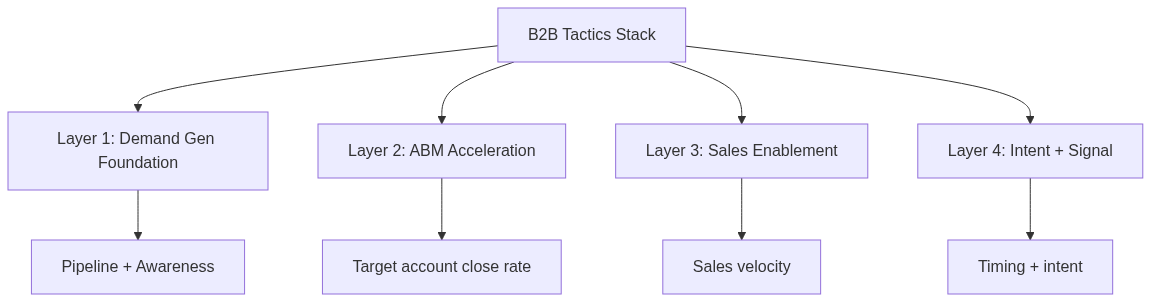
Layer 1 — Demand Generation Foundation
Demand Gen vs Lead Gen
| Aspect | Lead Gen | Demand Gen |
|---|---|---|
| Goal | Capture contact info | Create category demand |
| Tactic | Gated content (download form) | Ungated content (free read) |
| Metric | MQL volume | Brand search, direct traffic |
| Time horizon | Short (1-3 months) | Long (6-18 months) |
| Use case | Sales pipeline today | Build category leader |
Insight ปี 2026: lead gen แบบ gated form มี diminishing return — buyer ไม่อยากกรอก form แค่อ่าน whitepaper Demand Gen ที่ ungated สร้าง trust + brand affinity ที่ “ขับ MQL คุณภาพ” มากกว่า
Demand Gen Tactics ที่ work ปี 2026
1. Content + SEO Engine
– Pillar + cluster content ดู Content Marketing B2B Guide
– Long-form (2,000+ คำ) ที่ตอบ “How does X work”
– GEO (AI search) optimization ดู GEO Guide
2. Thought Leadership (Distributed)
– Founder/exec posting on LinkedIn 5-7x/สัปดาห์
– Podcast appearances (own / guest)
– Speaking at industry event
3. Industry Community + Newsletter
– Build owned community (Slack, Discord, LinkedIn group)
– Newsletter ที่ provide value > promotion (ดู Email Marketing B2B Guide)
4. Brand-driven Paid
– LinkedIn ads ที่ feature thought leadership (not “Download our ebook”)
– YouTube pre-roll ที่ deliver insight ใน 15 วินาที
– Sponsorship ของ industry newsletter / podcast
5. Distributed Content (Dark Social)
– Native LinkedIn post (not link to blog)
– Native Twitter thread
– Native YouTube video — keep ผู้ชมบน platform
Measurement (ที่ยาก)
ปัญหา: Demand Gen impact ไม่ track ได้ง่ายเหมือน Lead Gen — เพราะมัน influence buyer ก่อน track-able touchpoint
ทางวัด:
– Brand search volume — Google Search Console “queries containing brand name”
– Direct traffic % — ใน GA4
– Branded vs non-branded organic ratio — target > 30% branded
– Self-reported attribution — ถาม “ที่รู้จักเรามาจากไหน?” ตอน form submit
– Pipeline source — survey-based — quarterly review with sales
Layer 2 — Account-Based Marketing (ABM)
ABM คืออะไร
ABM = treat account (ไม่ใช่ individual lead) เป็น market — coordinate sales + marketing เพื่อ engage specific account แบบ personalized
ABM Tier Model
| Tier | จำนวน account | Personalization | Effort |
|---|---|---|---|
| 1:1 (Strategic) | 5-25 | สูงสุด — custom everything | สูงมาก |
| 1:Few (Industry/Segment) | 25-100 | Medium — by segment | Medium |
| 1:Many (Programmatic) | 100-500+ | ต่ำ — automated | ต่ำ |
ABM Process — 6 Steps
Step 1: Identify Target Account (ICP-fit)
– Firmographic filter (industry, size, revenue, location)
– Technographic filter (tech stack ที่ใช้)
– Intent signal (กำลัง research category)
– Total Addressable Market (TAM) sizing
Step 2: Map Buying Committee
สำหรับ 1:1 / 1:Few — research แต่ละ account ลึก:
– Decision maker (Title + name)
– Champion (likely advocate)
– Blocker (likely objector)
– User (will use the product)
– Economic buyer (signs the check)
Step 3: Create Personalized Content
– Microsite สำหรับ account ใหญ่ ($100K+ ACV)
– Custom case study ที่ใช้ industry คล้ายกับ account
– Personalized video (Loom / Vidyard) จาก exec
– Account-specific ROI calculator
Step 4: Multi-channel Orchestration
– LinkedIn ads targeted at the company (LinkedIn Account Targeting)
– Email sequence personalized to each persona
– Direct mail (yes, physical) สำหรับ Tier 1
– Sales outreach coordinated with marketing
– Webinar invite ที่ industry-specific
Step 5: Engagement Tracking
– Account-level dashboard (not just lead-level)
– Track: visit, content engagement, form fill, sales meeting
– Score engagement → identify “ready” account
Step 6: Measure + Iterate
Metric:
– Account engagement score
– Account → opportunity rate
– Opportunity → win rate
– Deal velocity (vs non-ABM cohort)
– ACV (vs non-ABM cohort)
ABM Tools
| Tier | Tool | ราคา/เดือน |
|---|---|---|
| Entry | HubSpot ABM + LinkedIn Ads | $50-500 |
| Mid | 6sense / Demandbase / RollWorks | $1,500-5,000 |
| Enterprise | Demandbase ABX / 6sense full | $5,000-20,000+ |
ABM Benchmark B2B (ปี 2026)
| Metric | Pre-ABM | Post-ABM (12 month) |
|---|---|---|
| Win rate | 15-20% | 25-40% |
| ACV | baseline | +30-60% |
| Sales cycle | baseline | -20-30% |
| Pipeline coverage | 3x quota | 4-5x quota |
Layer 3 — Sales Enablement
Sales Enablement คืออะไร
ชุดของ content + training + tool + process ที่ช่วย sales team:
– ปิด deal ได้เร็วขึ้น
– ปิด deal ได้บ่อยขึ้น
– ปิดด้วย ACV สูงขึ้น
– ลด ramp time ของ new hire
4 Components
1. Sales Content
– Sales deck (default + industry-specific versions)
– One-pager / battlecard (vs competitor)
– Case study (by industry + use case)
– ROI calculator + business case template
– Email template / sequence
– Demo script / video
2. Sales Training
– Onboarding playbook (first 30/60/90 days)
– Product training (deep technical)
– Sales methodology (MEDDIC, BANT, Sandler, ฯลฯ)
– Industry training (vertical-specific)
– Objection handling
3. Sales Tools
– CRM (HubSpot, Salesforce, Pipedrive)
– Sales engagement (Outreach, Salesloft, Apollo)
– Call recording (Gong, Chorus)
– Document tracking (DocSend, PandaDoc)
– Scheduling (Calendly, Chili Piper)
4. Sales-Marketing Alignment
– SLA (Service Level Agreement) — marketing → sales lead handoff
– Joint quarterly planning
– Closed-loop feedback (sales tells marketing what works)
– Lead scoring + qualification criteria
Sales Enablement Tactics ที่ work
Tactic 1: Battlecard (vs Competitor)
1-page summary ของแต่ละ competitor:
– Position + USP ของ competitor
– จุดอ่อน ที่เรา strong
– Common objection + response
– Win scenario (when we beat them)
– Loss scenario (when they beat us)
Tactic 2: Industry-Specific Sales Deck
Default deck = 30% เปลี่ยน, industry deck = 70% personalized
– Industry stat ใน opener
– Case study จาก same industry
– Use case ที่ specific
Tactic 3: ROI Calculator
ลูกค้ากรอก number → ระบบคำนวณ:
– Time saved per week
– Cost reduction
– Revenue uplift
– Payback period
ส่งกลับเป็น PDF — sales ใช้ใน follow-up
ดูเพิ่ม: ROAS / CPA / CPL Calculator — ตัวอย่าง calculator
Tactic 4: Demo Recording Library
– 5-10 demo video ของ use case ต่าง
– Sales ส่งให้ prospect ก่อน meeting
– ลด demo meeting requirement
Tactic 5: Customer Story Repository
– Searchable database ของ customer story
– Tag: industry / size / use case / outcome
– Sales filter ตาม prospect
Layer 4 — Intent Data + Signal-Based Selling
Intent Data คืออะไร
Data ที่บอกว่า account กำลัง research category ของคุณ — แม้ยังไม่ติดต่อ
3 sources:
– First-party intent — ของเรา (เว็บคุณ + tools)
– Second-party intent — partner ที่ share data
– Third-party intent — vendor (6sense, Bombora, ZoomInfo, Apollo)
Signal Types
| Signal | ตัวอย่าง |
|---|---|
| Web visit | Account browse pricing page 3+ ครั้งใน 30 วัน |
| Content engagement | Download multiple whitepaper ใน topic เดียว |
| Search behavior | Search keyword ใน category (จาก 3rd-party) |
| Job posting | Hiring role ที่ตรง use case ของเรา |
| Funding event | Recently raised → budget available |
| Tech stack change | Adding new SaaS — usually triggers buying cycle |
| News mention | Press release about pain ที่เรา solve |
Intent Data Tools
| Tool | Strength | ราคา/year |
|---|---|---|
| 6sense | Comprehensive intent + reveal | $40K-200K+ |
| Bombora | Pure intent data | $25K+ |
| ZoomInfo | Contact + intent + technographic | $15K-100K+ |
| Apollo.io | Affordable contact + intent | $1K-10K |
| Cognism | EU/UK focus | $20K+ |
| LeadSift | Social listening intent | $5K-15K |
| First-party (own) | Free | tool subscription |
Signal-Based Workflow
Intent signal detected
  → Score account (composite signal)
  → Trigger workflow:
    - Sales alert (high score)
    - Personalized ad (medium score)
    - Email sequence (low score)
  → Track engagement
  → Sales reach out at "right moment"
Best Practice
- Combine multiple signals — single signal noise, composite = signal
- Set threshold ที่ actionable — 100 alerts/วัน = sales ignore
- Map signal → action — ทุก signal มี SOP ว่าทำอะไรต่อ
- Measure outcome — signal-driven outreach vs cold = ดูว่า work จริงไหม
Putting It Together — B2B Tactics Stack ของ B2B Thai SME
Stage 1: Foundation (เดือน 1-6)
– Demand Gen content engine (P13 Content Marketing)
– Sales enablement basic (battlecard, deck, case study)
– CRM + intent tracking (first-party)
Stage 2: ABM Pilot (เดือน 7-12)
– Identify 30-50 target account
– 1:Few personalization
– Sales-marketing weekly sync
– LinkedIn Account Targeting ads
Stage 3: Scale (เดือน 13+)
– Expand ABM to 100-200 account
– Add 3rd-party intent tool
– Tier-based ABM (1:1 / 1:Few / 1:Many)
– Closed-loop reporting
Common Mistakes ของ B2B Tactics ในไทย
1. All-in ABM ก่อนมี Foundation
- Demand Gen ขาด = ABM ไม่มี content ใช้
- ทางออก: Demand Gen 6 เดือนก่อน ABM
2. ABM แบบ “spray and pray”
- เลือก 500 account แล้วส่ง email เหมือนกัน
- ทางออก: tier model — 1:Few สำหรับ 30-50 account ก่อน expand
3. ไม่ Align Sales-Marketing
- Marketing send lead → Sales ignore เพราะ quality ไม่ตรง
- ทางออก: SLA + weekly sync + closed-loop
4. Sales Enablement Content เก่า
- Pitch deck อายุ 18 เดือน + case study ไม่ update
- ทางออก: quarterly refresh program
5. ละเลย Intent Signal ของตัวเอง
- มี first-party intent (เว็บ visit) แต่ไม่ใช้
- ทางออก: เริ่มจาก first-party ก่อน invest 3rd-party tool
6. Demand Gen ที่ Promote มากกว่า Educate
- “Download our ebook” instead of “Here’s everything we know about X”
- ทางออก: 80% education, 20% promotion
7. ใช้ Tool ก่อน Define Process
- ซื้อ 6sense แต่ยังไม่มี workflow ที่ใช้ signal
- ทางออก: process แล้ว tool
Tools Stack สำหรับ B2B Thai SME
Stage 1: Foundation (~$200-500/mo)
- CRM: HubSpot Free → Starter ($45)
- Content: ChatGPT Plus ($20) + Ahrefs Lite ($99)
- Email: ConvertKit ($30)
- Analytics: GA4 + Search Console (Free)
Stage 2: ABM Pilot (~$700-1500/mo)
-
- LinkedIn Sales Navigator ($80) + LinkedIn Ads (variable)
-
- Apollo.io ($100)
-
- HubSpot Professional ($800)
-
- Calendly ($15)
Stage 3: Scale (~$3000+/mo)
-
- 6sense / Demandbase (negotiate)
-
- Gong / Chorus ($150-300/seat)
-
- Outreach / Salesloft ($100-150/seat)
-
- HubSpot Enterprise ($3,200+)
Action Plan — Build B2B Tactics Stack ใน 90 วัน
เดือน 1: Foundation
– Week 1: Audit current tactics + identify gap
– Week 2-3: Setup CRM + content engine
– Week 4: Sales enablement basic (deck, case study, battlecard)
เดือน 2: Demand Gen Push
– Week 5-6: Publish 2 pillar + 4 cluster content
– Week 7: LinkedIn thought leadership cadence
– Week 8: Newsletter launch + first 4 issue
เดือน 3: ABM Pilot
– Week 9: Identify 30 target account
– Week 10: Personalized outreach setup
– Week 11: Multi-channel orchestration
– Week 12: Review + plan scale
สรุป
b2b tactics ที่ work ปี 2026 ไม่ใช่ “ABM vs Demand Gen” — แต่คือ stack ที่ 3 layer working together:
หลักการสำคัญ:
– Demand Gen ก่อน ABM — ABM ปิด deal ที่ Demand Gen สร้าง awareness ไว้
– Sales Enablement = multiplier — ทุก dollar marketing × sales enablement quality = revenue
– Intent data = timing advantage — เริ่ม first-party ก่อน 3rd-party
– Buying committee mapping — 5-10 stakeholder ต้อง engage ทุกคน
– Closed-loop reporting — marketing-sales SLA + quarterly sync
อ่านต่อ:
– Content Marketing B2B Guide — Demand Gen foundation
– Marketing Framework B2B Guide — framework ใช้ structure tactic
– CRM B2B ไทย Guide — CRM = foundation ของ ABM + sales enablement
– Marketing Automation B2B — execute tactic ที่ scale
ถ้าอยากให้ทีม Adsitec ช่วย design B2B tactics stack ที่ฟิตกับ business ของคุณ — นัดคุย 30 นาที