Attribution & Marketing Mix Modeling สำหรับธุรกิจไทย ปี 2026
คู่มือ marketing attribution + MMM + MTA + incrementality testing สำหรับธุรกิจไทย ปี 2026 — last-click vs data-driven, GA4 attribution, MMM ราคาถูก, holdout test, calibration

TL;DR: Attribution ในไทยปี 2026 = ไม่มีคำตอบเดียว — ใช้หลาย model เทียบกัน. Last-click attribution ที่ใช้กันอยู่ overcredit Google + Meta paid และ undercredit organic + LINE + brand. คู่มือนี้ครอบคลุม: 6 attribution models (Last-click, First-click, Linear, Time-decay, Position-based, Data-driven), Multi-Touch Attribution (MTA) limitations หลัง iOS 14.5, Marketing Mix Modeling (MMM) ที่ทำได้ด้วย Meta/Google open-source tools, Incrementality Testing ผ่าน geo + audience holdout, attribution stack TH-specific (Meta + Google + TikTok + LINE + Marketplace), และ calibration framework
ทำไม Attribution ใน TH ยากกว่าฝรั่ง
Channel complexity:
– Meta + Google + TikTok + LINE + Shopee + Lazada + own site = 7+ channels
– LINE OA chat → conversion ไม่ tracked โดย Meta/Google
– Shopee/Lazada in-marketplace = closed ecosystem
– Cross-device (mobile → desktop → in-store) common
Privacy + Signal Loss:
– iOS 14.5+ ATT — 60-80% iOS users opt out tracking
– ITP (Intelligent Tracking Prevention) ใน Safari → cookies หมด 7 วัน
– Chrome 3rd-party cookies sunset (delayed but coming)
– PDPA + Consent Mode v2 → consent-based tracking
Result: Attribution data ที่เคยเชื่อถือได้ 2022 → 2026 มี gap 30-60% โดยไม่รู้ตัว
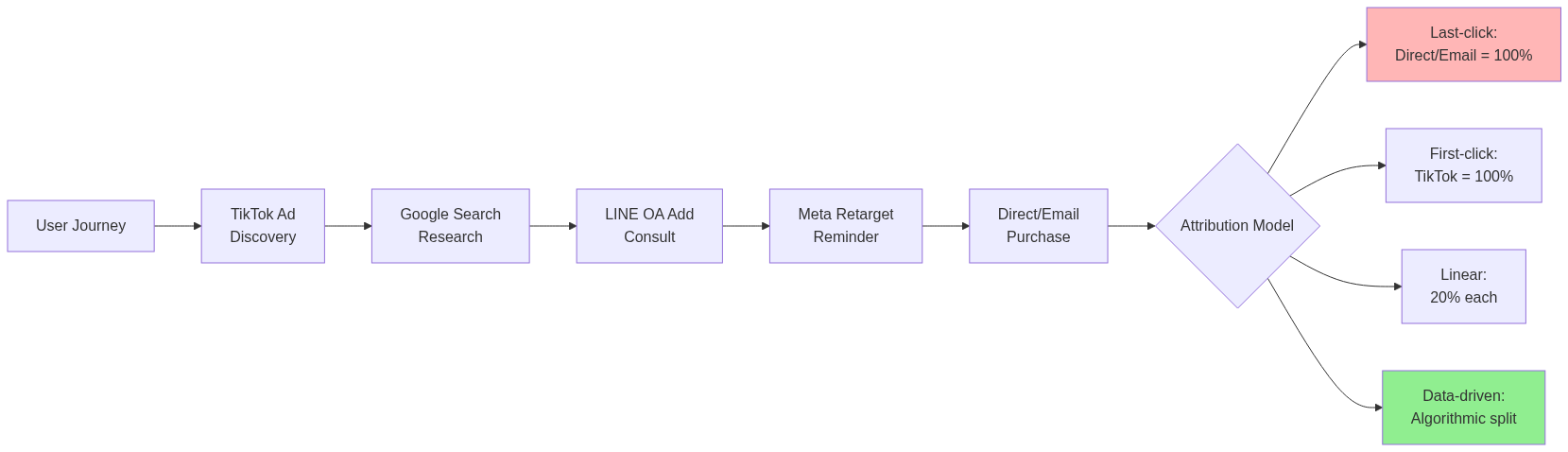
6 Attribution Models — เข้าใจให้ครบก่อนเลือก
1. Last-Click Attribution
- ให้เครดิต 100% กับ touchpoint สุดท้ายก่อน convert
- Default ใน Google Ads, Meta Ads, Shopee, Lazada
- ✅ Simple, fast
- ❌ Overcredit branded search, retargeting; ignore awareness channels
2. First-Click Attribution
- ให้เครดิต 100% กับ touchpoint แรก
- ✅ Highlight discovery channels (TikTok, YouTube, organic)
- ❌ Ignore decision-stage channels
3. Linear Attribution
- กระจายเครดิตเท่ากันทุก touchpoint
- ✅ Fair across funnel
- ❌ Treats all touches equally (ไม่จริง)
4. Time-Decay Attribution
- ให้เครดิตเพิ่มขึ้นตาม time ใกล้ conversion (exponential)
- ✅ Reflects influence proximity
- ❌ Still arbitrary weights
5. Position-Based (U-shaped / W-shaped)
- 40% first + 40% last + 20% middle (U-shaped)
- 30% first + 30% middle + 30% last (W-shaped)
- ✅ Recognize key milestones
- ❌ ยังเป็น rule-based, ไม่ใช่ data-driven
6. Data-Driven Attribution (DDA)
- Algorithm assign credit based on actual conversion paths
- Google Ads + GA4 default ปี 2024+
- ✅ Account for actual contribution
- ❌ Black-box, ยังจำกัดที่ data ใน 1 platform
Multi-Touch Attribution (MTA) — Limitations ปี 2026
MTA Tools เคยใช้กัน
- AppsFlyer / Adjust (mobile)
- Branch (cross-platform)
- Segment + custom
- HubSpot / Salesforce (B2B)
Why MTA Breaks ปี 2026
- iOS 14.5+ ATT → SKAdNetwork-level only
- ITP → Safari 7-day cookie cap
- LINE app browser = restricted cookies
- Cross-device = needs login ID linkage
Still Useful When
- B2B with logged-in CRM users
- Loyalty program with persistent ID
- Newsletter subscribers (email ID)
- 1st-party data rich (Customer Data Platform present)
Practical MTA Setup TH (2026)
- Identity resolution — match user ID across touchpoints (email hash, phone hash, LINE ID)
- Server-side tracking — Conversion API everywhere (Meta CAPI + Google EC + TikTok EAPI + LINE Conv API)
- GA4 as cross-channel aggregator
- Pipe to BI tool — Looker, Tableau, Metabase
Marketing Mix Modeling (MMM) — ปี 2026 Default for SME+
MMM คืออะไร
Top-down statistical modeling — predict business outcome (revenue) จาก marketing spend + external factors (seasonality, weather, competition, macroeconomics) โดยไม่ต้องใช้ user-level data
Why MMM Renaissance ปี 2024-2026
- Privacy-friendly (aggregate data, no PII)
- ทำงานได้แม้ ATT/ITP block tracking
- ครอบคลุม offline + brand + non-trackable channels
- Open-source tools ฟรี
MMM Tools (ใช้ได้จริง)
ฟรี / Open-source:
– Meta Robyn (R/Python) — most popular, Meta-built
– Google Meridian (Python) — newer 2024, Bayesian-first
– LightweightMMM (Google JAX) — academic
– PyMC-Marketing — flexible
Paid:
– Nielsen MMM (enterprise)
– Analytic Partners
– Marketing Evolution
– Recast — modern MMM
Data needed สำหรับ MMM
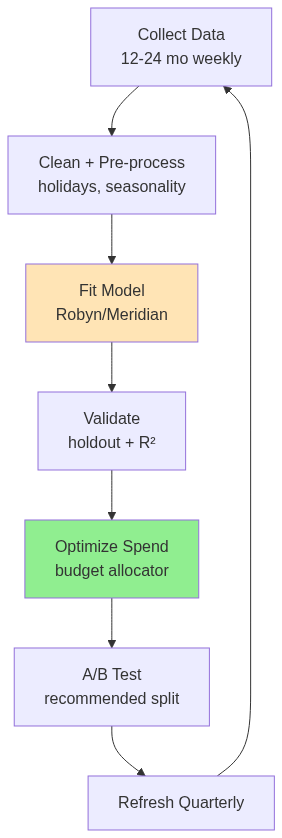
- Weekly/Daily marketing spend by channel (12-24 months min)
- Weekly/Daily revenue or conversions (same period)
- Control variables: seasonality, holidays, weather, competition events
- Optional: impressions, clicks, GRP
Process (simplified)
Common pitfalls
- Multicollinearity (channels move together)
- Insufficient variance (always same budget split)
- Overfitting to short period
- Confounding events (sale + ad blast same time)
- ใช้ MMM แทน MTA (different purposes — ควรใช้ทั้งคู่)
Incrementality Testing — Truth Layer
Attribution model ทั้งหมดยัง correlation-based. Incrementality testing = causation-based — measure true incremental contribution
Test Types
1. Geo Holdout
- หยุด channel ใน 1 city/region (control)
- เปรียบเทียบ conversion uplift vs control
- เหมาะกับ: Local-targetable channels (Meta, Google, TikTok)
- TH ตัวอย่าง: หยุด Meta Ads ใน Chiang Mai 4 สัปดาห์ → เทียบกับ Khon Kaen / Hat Yai
2. Audience Holdout (Ghost Bids / PSA Test)
- 10-20% of audience ไม่เห็น ad (placebo / PSA)
- Compare conversion rate between exposed vs holdout
- Meta + Google มี Conversion Lift studies tool
3. Switchback Testing
- Alternate channel ON/OFF ทุกสัปดาห์ในพื้นที่เดียวกัน
- เหมาะกับ short cycle product (impulse purchase)
4. Brand vs Generic Search Holdout
- Pause brand search ads → ดู organic recovery rate
- ปกติ 50-80% recover organic → brand search incremental ต่ำกว่าที่ attribution บอก
How often to test
- Quarterly minimum
- ทุก channel ที่ spend > 10% of total budget
- Before scaling new channel >2x
Attribution Stack TH-Specific
Cross-Platform Mapping
| Channel | Self-attribution | Cross-channel signal | Conversion API |
|---|---|---|---|
| Meta Ads | Pixel + CAPI (last-click 7d) | GA4 + UTMs | Yes |
| Google Ads | DDA (default 2026) | GA4 + Enhanced Conv | Yes |
| TikTok Ads | Pixel + EAPI | UTM + GA4 (limited) | Yes |
| LINE Ads | LINE Tag + Conv API | Manual UTM | Yes |
| Shopee Ads | Internal only | UTM external only | No native |
| Lazada Ads | Internal only | UTM external only | No native |
| Open + click | GA4 + email link UTM | N/A | |
| Direct | None | GA4 referrer | N/A |
TH-Specific Tracking Gaps
- Shopee/Lazada in-app — closed ecosystem, no upstream attribution
- LINE → OA chat → manual close — depends on admin log
- Marketplace return rates ไม่นับ ใน first-pass ROAS
- Cash on Delivery (COD) orders — return rate 15-30% ปกติ TH
Recommended Stack
1. GA4 — cross-channel aggregator
2. Server-side tagging (GTM Server) — CAPI for all 5 platforms
3. CRM/CDP — identity resolution + offline conversion
4. Marketplace data — manual import weekly
5. MMM (quarterly) — true incremental
6. Incrementality tests (quarterly per channel)
Calibration Framework
ใช้หลาย model + reconcile
Step 1: ดูทุก source
- Meta Ads Manager ROAS
- Google Ads ROAS
- TikTok ROAS
- LINE ROAS
- Shopee Seller Center
- Lazada Seller Center
- GA4 attribution
- Bank statement (actual revenue)
Step 2: Compare ratio
- Platform-reported revenue / Total revenue
- ปกติ sum > 100% → double-counting
- Calibration factor = Actual / Sum-reported
Step 3: Apply Discount
- เช่น Meta reports 1.5M, Google 1.2M, TikTok 0.5M, LINE 0.4M = 3.6M
- Actual = 2.8M
- Calibration = 0.78 (discount each by 22%)
Step 4: Cross-validate with MMM + Incrementality
- MMM should show similar relative contribution
- Incrementality test แม่นที่สุดสำหรับ marginal decisions
Common Pitfalls
- Trust Last-Click only → overspend retargeting + branded search
- Skip Incrementality test → never know real causal contribution
- Run MMM on < 12 months data → unreliable
- No identity resolution → MTA breaks for cross-device users
- Forget Shopee/Lazada attribution gap → over-credit Meta for marketplace conv
- Apply Google DDA to GA4 cross-channel → mixing model paradigms
- Don’t reconcile reported vs actual revenue → make decisions on inflated numbers
- Quarterly review only → missed seasonal anomalies
Decision Framework: เลือก Attribution อะไรเมื่อไหร่
| Decision | Best Model |
|---|---|
| Daily channel bid optimization | Last-click + DDA (within-platform) |
| Weekly budget reallocation | GA4 cross-channel + UTM |
| Monthly channel mix review | MMM + Incrementality |
| Quarterly strategic planning | MMM + Calibration + Incrementality |
| New channel test | Incrementality (geo or audience holdout) |
| Brand vs Performance split | MMM + Brand lift studies |
Quick Start Checklist
Week 1-2 — Foundation
- [ ] Enable Conversion API ทุก platform (Meta, Google, TikTok, LINE)
- [ ] Setup GA4 with custom channel grouping
- [ ] UTM standard across ทุก campaign
- [ ] Import Shopee/Lazada sales data weekly
Month 1 — MTA Layer
- [ ] Identity resolution (CRM email/phone hash)
- [ ] Cross-channel reporting in BI tool
- [ ] Reconcile reported vs actual revenue monthly
Month 2-3 — MMM Foundation
- [ ] Gather 12+ months data (spend + revenue + control vars)
- [ ] Setup Robyn or Meridian
- [ ] Run initial model + validate
- [ ] Quarterly refresh cadence
Month 3+ — Incrementality
- [ ] Run geo holdout test (1 channel)
- [ ] Run audience holdout (Meta Lift Study)
- [ ] Build internal capability for quarterly testing
บทความที่เกี่ยวข้อง
- MarTech Analytics & Tracking Guide — GA4 + GTM Server + CAPI setup
- Meta Ads สำหรับ B2C — Meta Pixel + CAPI deep dive
- Google Ads สำหรับ B2C — Enhanced Conversions + DDA
TL;DR ย้ำ: Attribution ปี 2026 = multi-model + calibrated + incrementality-validated. Last-click อย่างเดียว = ตัดสินใจผิด. MMM ใช้ Robyn/Meridian ฟรี. Incrementality test รายไตรมาส. Reconcile platform-reported vs actual revenue — discount ratio ปกติ 20-40% สำหรับ TH multi-channel
อ่านเพิ่มเติม — Pillar Guides ที่เกี่ยวข้อง
- MarTech Analytics & Tracking Guide สำหรับ B2B ปี 2026 — GA4, GTM, Server-side, CAPI
- CRM B2B ไทย 2026: คู่มือเลือก HubSpot, Salesforce, Segment
- Attribution Model B2B 2026: คู่มือวัดผลแคมเปญฉบับสมบูรณ์
- Marketing Automation B2B: คู่มือเลือก Klaviyo, Customer.io, Mailchimp 2026
- Privacy & First-Party Data B2B Guide — PDPA, Cookieless, Consent ปี 2026