Data Stack สำหรับ E-commerce / D2C ในไทย ปี 2026
คู่มือ data stack สำหรับ e-commerce และ D2C ในไทย ปี 2026 — Shopify, Klaviyo, Segment, BigQuery, GA4 e-com, attribution, customer.io, retention stack

Data Stack สำหรับ E-commerce / D2C ในไทย ปี 2026
TL;DR: E-commerce / D2C data stack 2026 = Shopify/Woo + Klaviyo + GA4 + Segment + BigQuery + Reverse ETL. Differ จาก B2B stack: focus ที่ purchase events + LTV + cohort + retention มากกว่า lead score + ABM. คู่มือนี้ครอบคลุม: e-com platform choice, email/SMS automation (Klaviyo/Customer.io), CDP role for D2C, warehouse setup, attribution gaps with marketplace (Shopee/Lazada), LTV modeling, retention stack, subscription handling
E-com Data Stack ต่างจาก B2B ยังไง
| มิติ | B2B Data Stack | E-com / D2C |
|---|---|---|
| Primary CRM | HubSpot/Salesforce | Shopify/WooCommerce (= “CRM” effectively) |
| Email Engine | Marketo/Pardot | Klaviyo / Omnisend / Customer.io |
| Critical Event | Demo request / SQL | Purchase + AOV + LTV |
| Funnel Length | 30-180 วัน | <7 วัน (often <1 hour) |
| Identity | Email + Company | Email + Phone + LINE ID |
| Activation | Sales workflow | Email/SMS lifecycle automation |
| Attribution | Multi-touch over months | Last-click + DDA, short window |
| Subscription | Annual contract | Recurring purchase (subscription model) |
| 3rd-party Data | Firmographic | Behavioral + Lookalike audiences |
E-commerce Platform Choice
Shopify (Cloud SaaS)
Best for: D2C, fast launch, ≤$10M GMV
✅ Pros:
– Fastest setup (days, not months)
– Best-in-class app ecosystem
– Native integrations: Meta, Google, TikTok, Klaviyo
– Payment integrations (TH: PromptPay, Omise, 2C2P)
– Mobile-first checkout
❌ Cons:
– Monthly fee + transaction fee
– Less customization than self-hosted
– Plus tier ($2k/month) needed for scale
TH pricing 2026: Basic $39, Shopify $105, Advanced $399, Plus $2k+/month
WooCommerce (Self-hosted WordPress)
Best for: Already on WordPress, content+commerce mix, custom needs
✅ Pros:
– Free core
– Full customization
– Many plugins
– TH agencies many
❌ Cons:
– Self-host = manage server
– Performance tuning required
– Security responsibility
– Slower checkout (without optimization)
TH common stack: WooCommerce + Cloudways/Kinsta hosting + premium plugins
LINE MyShop
Best for: TH-native, leverage LINE OA followers
✅ Pros:
– In-LINE checkout
– High conversion rate (TH-trust)
– Free to start
– TH-native payment + delivery
❌ Cons:
– Limited customization
– LINE-only ecosystem
– Less reporting depth
Marketplace-only (Shopee + Lazada)
Best for: Test product, leverage marketplace traffic, ไม่ต้องสร้าง brand site
❌ Limitation: ไม่ได้ customer data — marketplace owns it
Recommendation by stage
- Test product: Marketplace + LINE MyShop
- Brand validation: Shopify + Marketplace
- Scale: Shopify Plus + WooCommerce + Marketplace + LINE
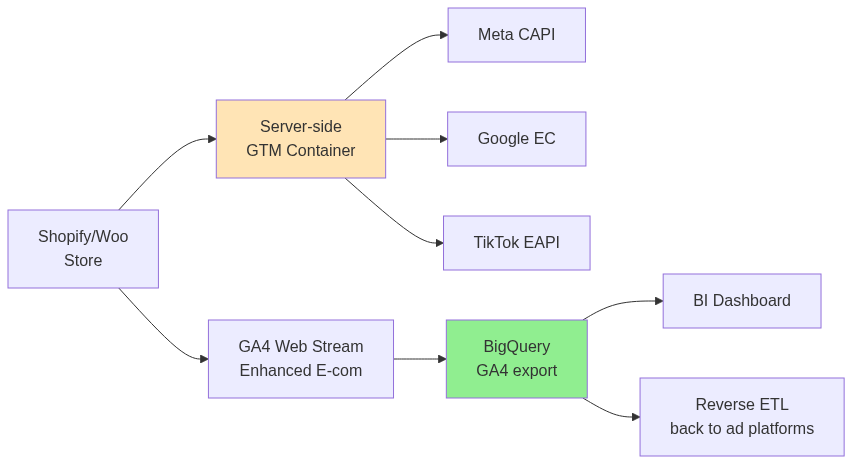
GA4 E-commerce Setup
Required Events (Enhanced E-commerce)
view_item            — product detail page
view_item_list       — category page
select_item          — click product card
add_to_cart
remove_from_cart
view_cart
begin_checkout
add_shipping_info
add_payment_info
purchase             — primary conversion
refund               — if applicable
Implementation
- Shopify: Native GA4 setup via Shopify Admin → Sales Channels → Google Channel
- WooCommerce: Plugin “GA4 for WordPress” หรือ GTM
- Custom: GTM Server-side container — recommend สำหรับ accuracy
Key Reports
- Monetization → E-commerce purchases — revenue + items
- Acquisition → Traffic acquisition — channel attribution
- User → User lifetime — LTV cohorts
- Custom Audiences for Ads — push to Meta/Google
Klaviyo — Email + SMS Engine
Why Klaviyo dominates D2C
- Built for e-com (vs HubSpot, Mailchimp generic)
- Native Shopify integration (deep, real-time)
- Pre-built flows (cart abandon, welcome, post-purchase)
- Segmentation based on purchase behavior
- AI-powered send time + subject line
Klaviyo Pricing
- Free: ≤250 contacts + 500 email sends/month
- Email: $30-$2000+/month (scale by contacts)
- SMS: $5 base + per-message (TH: ~0.50-1.50 บาท/SMS)
Core Flows ต้องมี
- Welcome Series — 3-5 emails after subscribe
- Abandoned Cart — 1-3 emails, 1 hour / 24 hr / 72 hr
- Abandoned Browse — viewed product, didn’t add
- Post-Purchase — thank you + delivery + review request
- Win-back — inactive 60-90 days
- VIP — top 10% customers
TH-Specific
- SMS still works in TH (used for OTP + delivery notifications)
- LINE integration via 3rd-party plugin (Klaviyo → LINE OA broadcast)
- Email open rates lower TH (~15-20% vs 25-30% US) — adjust expectations
Alternatives
- Omnisend — cheaper, similar feature set
- Customer.io — more flexible, dev-led
- Postscript — SMS-first
- Mailchimp — last resort (weak for e-com)
CDP for E-com — Different Profile
When E-com needs CDP
- Multi-store (Shopify + Marketplace + LINE MyShop)
- Subscription business (recurring billing)
- App + Web both
-
500k MTU
Klaviyo as Light CDP
Klaviyo for many TH D2C = good enough as “CDP-lite”:
– Profile data
– Behavioral events
– Segmentation
– Activation to Meta/Google audience
Proper CDP
- Segment — for multi-source
- RudderStack — open-source friendly
- Tealium — enterprise
When to graduate
- Need data ใน warehouse for BI/MMM
- Multiple email/SMS tools needed
- Custom destinations (Snowflake → custom internal app)
Subscription / Recurring Stack
Subscription Tools
- Recharge (Shopify) — most popular
- Bold Subscriptions
- Loop Subscriptions
- Native: Shopify Subscriptions — basic but free
Subscription Data Challenges
- LTV calculation (cohort-based)
- Churn modeling
- Trial-to-paid conversion
- Subscription pause/cancel reasons
Data Stack Add-ons for Subscription
- Push subscription events → CDP/warehouse
- Build cohort retention dashboard
- Trigger flow on churn risk (Klaviyo)
Marketplace Data Integration
Problem: Marketplace = Closed Data
Shopee/Lazada sell ให้ลูกค้าคุณ — แต่คุณไม่เห็น:
– Customer email (Shopee masks)
– Customer phone (masked)
– Browse behavior before purchase
– Cross-purchase data
What you CAN get
- Order data (export weekly)
- Customer name + shipping address
- Order value + items
- Repeat purchase rate (in-marketplace)
How to Integrate
- Manual CSV export → warehouse (weekly)
- 3rd-party tool: SellerCenter sync, Shippop
- Build custom scraper/API
Activate Marketplace Data
- Calculate true cross-channel LTV
- Identify cross-platform customers (same address/phone)
- Build lookalike on Meta from marketplace buyers (use email hash if available)
LTV Modeling
Why LTV matters more than ROAS
- ROAS = single transaction
- LTV = total revenue per customer over lifetime
- D2C with subscription/repeat = LTV often 3-10× first purchase
- Optimize CAC vs LTV, not vs first-order revenue
Simple LTV Formula
LTV = AOV × Purchase Frequency × Gross Margin × Customer Lifespan
Example:
– AOV: 1,500 บาท
– Frequency: 4× per year
– Gross margin: 40%
– Lifespan: 3 years
– LTV = 1,500 × 4 × 0.40 × 3 = 7,200 บาท
Cohort-Based LTV
แบ่งลูกค้าตามเดือนที่ acquired → track revenue per cohort over time
Predictive LTV
Use machine learning to predict LTV early (เช่นจากการซื้อแรก)
– Tools: GA4 Predictive Audiences, custom in BigQuery ML
– Use case: bid higher for high-pLTV customers ใน Meta/Google
Retention Stack
Tools (beyond email)
- Loyalty programs: Smile.io, Yotpo, LoyaltyLion
- Reviews: Yotpo, Stamped, Judge.me
- UGC: Stamped UGC, Loox
- Referrals: ReferralCandy, Stamped, Friendbuy
- SMS: Postscript, Attentive (US-focused), local TH SMS
TH-Specific Retention Channel
- LINE OA — broadcast, 1:1 chat, rich menu
- LINE Stamp — engagement
- LINE MyShop — repurchase friction-less
Retention KPIs
- Repeat purchase rate
- Customer Retention Cohorts (% returning by month)
- 90-day repeat rate
- LTV/CAC ratio (>3 healthy)
Reverse ETL Use Cases for E-com
- Custom Audience push — top customers, churn risk
- Suppression list — exclude purchasers from prospecting ads
- Lookalike seeds — high-LTV customers → Meta/Google LAL
- Email segmentation — based on warehouse-calculated traits
- CRM enrichment — push behavior back to CRM
Tools
- Hightouch (most popular)
- Census
- RudderStack (open-source)
Privacy + PDPA for E-com
Consent Capture
- Cookie banner at site visit
- Email opt-in at checkout (separate from terms)
- SMS opt-in explicit (TH PDPA + telco rules)
- Marketing communications opt-in
Data Retention
- Customer order data — keep for tax (7 years TH)
- Behavioral data — 1-2 years standard
- Inactive customer — delete after 2 years
Right to Delete
- Process within 30 days TH
- Document delete: warehouse, CRM, Klaviyo, ad platforms
Stack by Stage
Stage 1: First $100k GMV (1-12 months)
- Shopify Basic + Theme
- Klaviyo Free / Starter
- GA4 + Meta Pixel + CAPI (via Shopify channel)
- Google Sheets for marketplace data
- Cost: $50-300/month
Stage 2: $100k-$1M GMV (12-24 months)
- Shopify Shopify tier
- Klaviyo Email + SMS
- GA4 + BigQuery export
- Recharge if subscription
- Reviews (Yotpo)
- Cost: $500-2,500/month
Stage 3: $1M-$10M GMV (24+ months)
- Shopify Advanced
- Klaviyo Pro tier
- Segment + BigQuery + dbt
- Hightouch for activation
- Predictive LTV in BigQuery ML
- Cost: $3,000-15,000/month
Stage 4: $10M+ GMV (Enterprise)
- Shopify Plus / Headless
- Segment Business + Klaviyo Custom
- Snowflake / BigQuery production
- Custom data team (2-5 people)
- MMM + Incrementality testing
- Cost: $30,000+/month
Common Pitfalls
- Trust Shopify reports — Shopify last-click = overstate Meta
- No CAPI → Meta/TikTok signal loss 30-40%
- Marketplace orders not in warehouse — incomplete picture
- Single attribution model — ROAS lies (see attribution guide)
- Email broadcast instead of behavior-triggered — low engagement
- No subscription analytics — churn surprise
- Customer ID fragmented — guest checkout = anonymous
- Stack without ownership — tools rot
- Skip predictive LTV — bid same on everyone
- Focus on AOV, ignore LTV — short-term ROAS, long-term loss
Quick Start Checklist
Week 1-2 — Foundation
- [ ] Shopify + Klaviyo + GA4 setup
- [ ] Meta Pixel + CAPI via Shopify channel
- [ ] Google Channel app for Merchant Center
- [ ] TikTok Pixel + EAPI
Month 1 — Core Flows
- [ ] Welcome Series
- [ ] Abandoned Cart (3-email)
- [ ] Post-Purchase + Review request
- [ ] Win-back
- [ ] BigQuery export from GA4
Month 2-3 — Data Layer
- [ ] Marketplace data weekly import
- [ ] Basic LTV dashboard in BigQuery
- [ ] Custom Audience automation (Klaviyo → Meta)
- [ ] Subscription analytics (if applicable)
Month 4+ — Optimization
- [ ] Predictive LTV
- [ ] MMM model (quarterly)
- [ ] Reverse ETL for ad platform activation
- [ ] Cohort retention dashboard
บทความที่เกี่ยวข้อง
- Data Stack สำหรับ B2B — companion for B2B
- MarTech Analytics & Tracking Guide — GA4 + GTM Server
- Attribution & Modeling Guide — MMM + Incrementality
- Meta Ads สำหรับ B2C — Catalog + DPA setup
- LINE & Marketplace Ads Guide — TH commerce ecosystem
TL;DR ย้ำ: E-com data stack 2026 = Shopify + Klaviyo + GA4 + BigQuery + Reverse ETL. Focus ที่ LTV cohort + retention, ไม่ใช่แค่ ROAS ครั้งแรก. Marketplace data ต้อง manual import. Predictive LTV + custom audience push คือ unlock การ scale CAC ที่ profitable
อ่านเพิ่มเติม — Pillar Guides ที่เกี่ยวข้อง
- MarTech Analytics & Tracking Guide สำหรับ B2B ปี 2026 — GA4, GTM, Server-side, CAPI
- CRM B2B ไทย 2026: คู่มือเลือก HubSpot, Salesforce, Segment
- Attribution Model B2B 2026: คู่มือวัดผลแคมเปญฉบับสมบูรณ์
- Marketing Automation B2B: คู่มือเลือก Klaviyo, Customer.io, Mailchimp 2026
- Privacy & First-Party Data B2B Guide — PDPA, Cookieless, Consent ปี 2026